
RII31220 Certificate III in Civil Foundations
Civil Construction Course
Become a skilled Civil Foundations worker.
Want the competitive edge in your career?
Need to meet your tender or contract requirements?
Ready to step into being a skilled construction worker?
The RII31220 Certificate III in Civil Foundations covers the technical and practical skills needed to work effectively in civil construction. You’ll learn a broad range of skills relevant to general civil construction occupations and large scale infrastructure projects.
In this civil construction course, you will develop capabilities in infrastructure and building site preparation which will offer many different career options for those who love to get their hands dirty and don’t want to spend their days inside an office.
The RII31220 Certificate III in Civil Foundations is a nationally accredited qualification.
Turn Learning into Career Success
- Pave your way with a nationally recognised qualification for greater career opportunities
- Achieve your goals with practical experience while you earn
- Support from highly qualified trainers
- Flexible study options available – earn while you learn*
RII31220 Certificate III in Civil Foundations
An in-depth look at the course, to download your own copy, click ‘DOWNLOAD COURSE BROCHURE’ below.


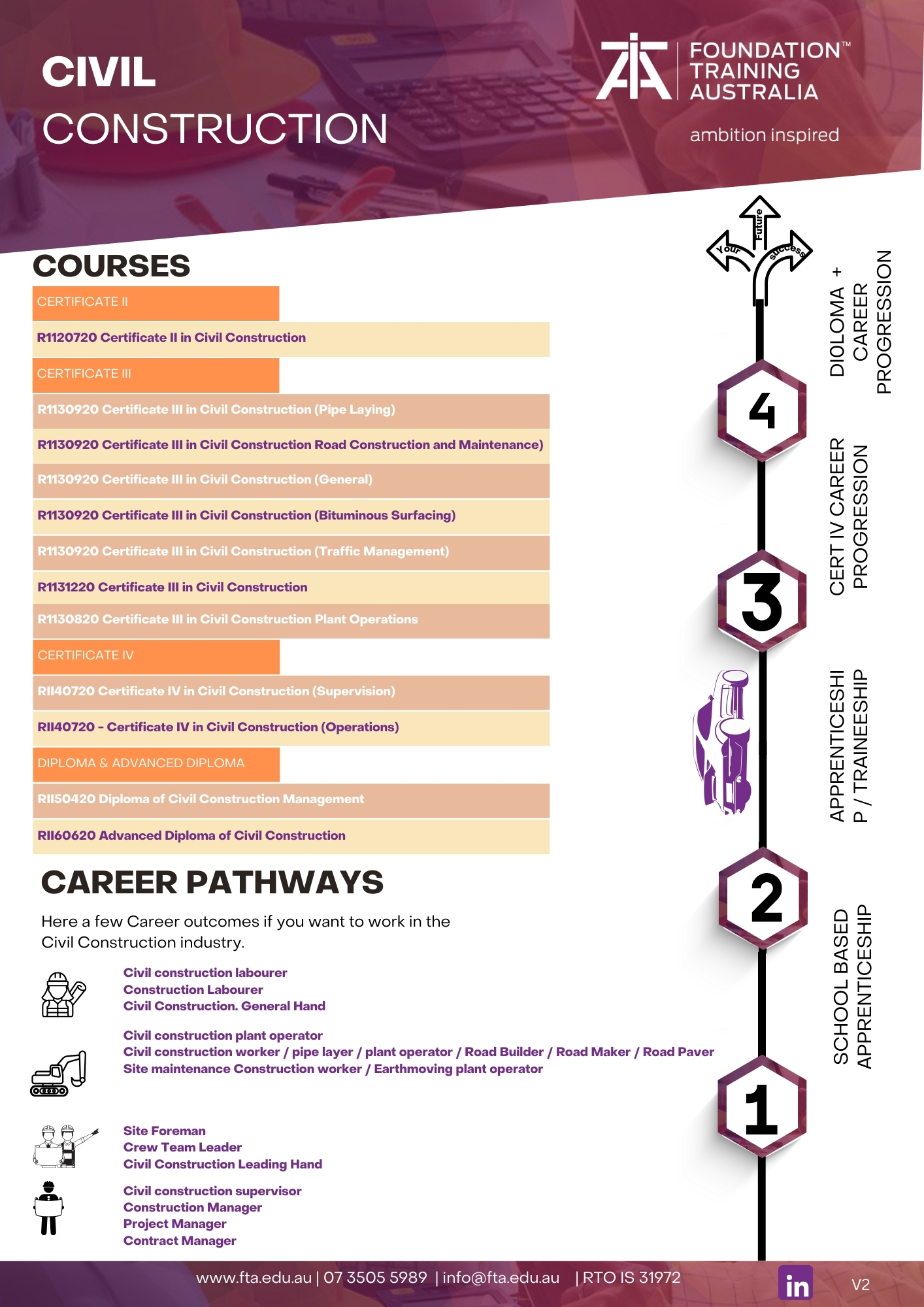
Course Structure What this course offers
This civil foundations course is the accepted entry-level qualification required to work on civil construction sites. It is aimed at anyone wanting to work in roles that support infrastructure projects, you’ll learn skills in infrastructure development, bridge works, drainage and rectification works.
To achieve this qualification, you must demonstrate competency in all 15 core and 11 elective units. Refer below for the core units of competency and a sample of suggested electives:
Core Units (15)
- RIIBEF201E – Plan and organise work
- RIICCM201E – Carry out measurements and calculations
- RIICCM202E – Identify, locate and protect underground services
- RIICCM203E – Read and interpret plans and job specifications
- RIICCM205F – Carry out manual excavation
- RIICCM207E – Spread and compact materials manually
- RIICCM208E – Carry out basic levelling
- RIICOM201E – Communicate in the workplace
- RIIRIS301E – Apply risk management processes
- RIISAM201E – Handle resources and infrastructure materials and safely dispose of nontoxic materials
- RIISAM203E – Use hand and power tools
- RIISAM204E – Operate small plant and equipment
- RIIWHS201E – Work safely and follow WHS policies and procedures
- RIIWMG203E – Drain and dewater civil construction sites
- RIIWMG301E – Control construction site water tables
Suggested Elective Units (11)
- AHCSAW301 – Construct conservation earthworks
- RIICFW305E – Conduct cast in-situ pilings operations
- RIICFW306E – Direct pile driving operations
- RIICFW307E – Direct cast in-situ piling operations
- RIICRC306E – Conduct earthworks
- RIIIMG301E – Maintain site records
- RIIWHS302E – Implement traffic management plans
- RIICCM210E – Install trench support
- RIIQUA201E – Maintain and monitor site quality standards
- RIIRIS201E – Conduct local risk control
- RIIRIS202E – Respond to site-based spills
When you’ve just won a tender, we get that it’s all hands on deck. That means getting in onsite, training your crew up and ensuring you are compliant with your tender obligations, without delaying the progress of your project. We know how important this is and that’s why we’re here to support what you need now and in the future.
- Customised training plans that suit your timeline requirements
- Our Trainers share your background, having worked in civil construction for years, they are current with industry.
- We are known for being responsive.
- Meet your contract training requirements.
- We work in partnership with the Australian Apprenticeships Network.
- Eligible employers can access subsidies for Apprenticeships. Ask our team if you’re eligible!
- Onsite training, we come to you.
- Leading Hand (Civil Construction)
- Civil Construction Plant Operator
- Construction worker
The course duration will vary depending on your experience, skills and chosen study mode. As a guide:
- Apprenticeship: Between 12 – 36 months years depending on the type of apprenticeship and the apprentice’s ability
- Recognition of Prior Learning (RPL): 3-6 months- this term may be extended by Funding Criteria, amount of RPL awarded and subsequent Gap Training required – eligibility criteria apply
- Fee for Service: 3-12 months subject to the amount of RPL awarded and subsequent Gap Training required
Your skills will be assessed through a mix of practical and theory tasks. Which is essentially showing us what you’ve learnt and how you do it.
Theory will be assessed via Workbook. Practical Assessment will be conducted at your place of work or worksite with fit for purpose facilities and equipment which are to be made available to your FTA trainer & Assessor for training and assessment purposes.
Begin Your Journey
Our Difference

Learner Support

Limitless Learning
